


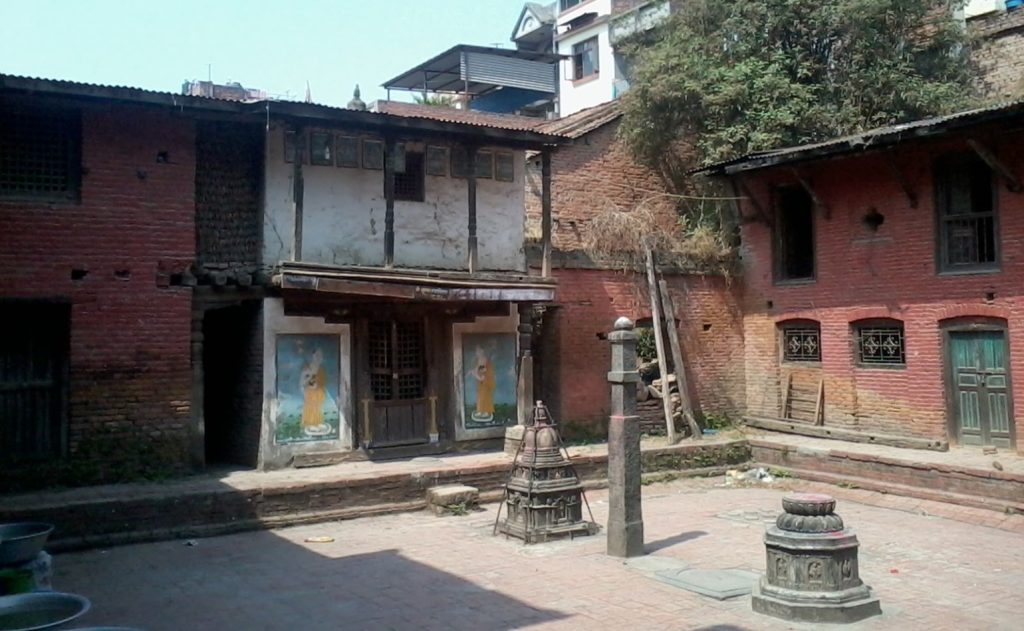
Gustala Mahavihar
Introduction
Location: Guitole, Patan, Lalitpur
Style: Bahil Courtyard
Constructed: Lichhavi Period
Deity: Lokeshwor
Renovated: After NS 375, after 1934 AD
Authority: Guita Bahi
Records: NS 144, 375, 399, 368
Description
Guita bahi refers to three Bahils namely Pratham Shree Mahabihar, Vasucchasheela Mahabihar and Gustal Mahabihar located at the eastern most edge of the old Patan. This place rich with a number of attributes, cultural practices and rituals. This includes daily puja ritual called ‘dekhya cayeke’, recitation of hyms called ‘tutah’ in every full moon, half-moon and first day of the month of Nepalese solar calander. All three bahils are run by their own Sangha (a monastic institution) headed by five senior monks. These five senior monks have rights to order a shakya boy as monk for four days and grant the membership of sangha.
Historical Background
These three bahils are ancient monasteries dated back at least from Licchavi period (1st century to 10th century C.E.). It is testified by number of antiquities and remnants such as inscriptions written in Licchavi script, an image from 6th century and Lichhavi Chaityas, etc. Other inscriptions of Nepal Era (NS) 144, 399 and 368 are among the oldest one. The NS 399 inscription is the most referred one by scholars which reads about the fact that Lalitpur had been the center for Buddhist learning and practice. The older inscriptions bearing the name of Bihar as ’Gustala’ in all three bahils suggest that there was only one big bahil in the past called ‘Gustala Mahabihar’. Later it was divided into three and got different names for each.
Different scholar have proposed their interpretations about the history of this place. Prof. S.R. Tiwari poses his conclusion referring to the words ‘Gutashinko Pradesha’, ‘Nava Vam’ and ‘Gusatala’ found in manuscripts and inscriptions. The place is designated as the ninth sector when Patan city was planned in a nine squared mandala form. In local Newari language , 9 is ‘gu’ and land is ‘tala’. Hence , ‘Gustala’ literally means the land lying in the sector 9. He also claims that Lichhavi King Narendra Dev constructed Bhadradivas Bhawan at the present site of Guita Don. The monastic as well as other settlement developed was started in his period. Furthermore, the residents and the philantrophists constructed 9 such objects in the quantity of 9 such as:
- Nine wells
- Nine chaityas
- Nine hiti (stone water spout)
- A pati with nine bays of the columns
- A tradition of offering dana sitting in that pati which includes nine spoon of rice from the nine Jasi (container)
- A pond consecrated inviting nine nagarajas (the great serpents)
- A nine storied temple
- A traditions of recitinging Nava Grantha (9 great scripture)
- Endowmwents of nine hundred and ninty laye (an unit measurement) of land.
Cultural Aspect
This bahi observes a festival in the month of Gunla (July/August) each year, in which a scared water spout called ‘Dhanlyahiti’ is displayed. Thousands of devotees visit this place on the 1st day after the New moon in August to see these display. This display of spout is a traditional means of educating and reminding lay people about the truth of death. The water spout signifies an object of transcendental realm where a person’s soul is taken away just before the moment of death. Besides, this display also includes the idol of Amoghpasa and two Taras, 34 feet long scroll painting, an image of Guita Aji, image of Dipankara, wooden image of Avalokiteshvara and collection of antique utensils.
Description of the Guita Bahi
Guita bahi, also termed as Pratham Shree Mahabihar is the largest one among the three bahi. Main entrance to the bahi is from east. The entry house consist of ‘Dalan’. After the entry, one can find the image of Mahankal and Bishwakarma to the left. Then to the south corner of the bahi, there is newly constructed traditional styled 2 storey building in which a scared water spout called ‘Dhanlyahiti’ is displayed in the month of Gunla (July/August). Around the bahi, Sanghas live. Main temple is at the southern part of the bahi which is once believed as a 9 tiered temple but there is no strong point to support this. Presently it is under reconstruction. According to description, the temple is two storied with two sided sloped roof and a small pagoda styled portion called ‘Phucha’ on top of the roof. The temple faces towards north. The temple’s plinth is 5 feet raised above the bahi ground level. Just at the top of plinth, there is Dharmadhatu. The temple has double wall construction system with circumambulation space. The outer wall is of 2 feet thick and the front face consisted of three bayed single timber column frame. Front face of the inner wall consist of a beautifully carved wooden door of opening height 6’-6” which leads to sanctum and 18 small prayer wheels (8 on right and 8 on left of the door). The door rested upon stone base of 10” height. Inside the sanctum, there is a large metal idol of standing ‘Maitriya Buddha’. The idol is of 8 feet tall, which means the floor height is of about 9 to 10 feet.
High plinth, tall idol, large sanctum, thick outer wall (2 feet) and art of 9 storey temple in scroll painting are some of the hints that suggest it was a tall structure (9 storey temple) during ancient time. Just in front of the temple, there is stone mandala. Behind this, there is a Dharmadhatu with Bajra above. Behind this is a chaitya of Licchavi period. Behind it, there is again Dharmadhatu then after a stone bajra above the low height stone pillar. After this there is again a chaitya. Other two bahi namely Vasucchasheela Mahabihar and Gustal Mahabihar are located to the north and joined with this bahi.
Full Report >>>

Leave a Reply